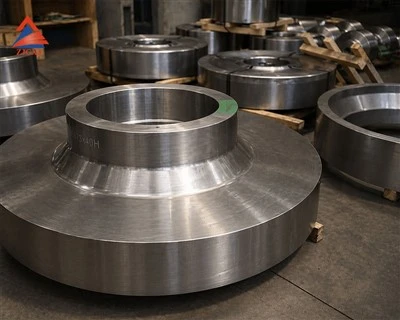
If you’ve ever stood in a plant maintenance workshop, watching a crew tighten a bolt on a high-pressure steam line or double-check a flange seal on a chemical processing system, you know forged flanges are more than just metal discs with holes. They’re the unsung connectors that hold industrial systems together, and ANSI forged flanges are the global standard for reliability, consistency, and performance across millions of applications. As a forged flange supplier with 18 years in the game, I’ve spent thousands of hours walking customers through everything from spec sheets to on-site installations, and one question comes up more often than most: “What are the dimensions of ANSI forged flanges?” Forged Flange

It’s not a trivial question. Dimensions aren’t just numbers on a paper chart—they’re the difference between a leak-free, 20-year pipeline and a costly shutdown that costs a plant six figures in lost production. ANSI (American National Standards Institute) has spent decades refining these dimensions to eliminate guesswork, but there are still common misconceptions even among veteran engineers. Let’s break down the core dimensions that define ANSI forged flanges, how they’re structured, and why they matter for your next project.
First, let’s get a quick grounding in the two most common ANSI standards for forged flanges, because “ANSI” alone doesn’t tell the full story. The vast majority of industrial forged flanges fall under ANSI B16.5, which covers flanges for pipe sizes NPS 1 through NPS 24, pressure classes 150, 300, 400, 600, 900, 1500, and 2500. For larger pipes (NPS 26 and above, up to NPS 60), we use ANSI B16.47, which has its own set of dimensions tailored for heavy-duty, low-to-medium pressure applications. Every dimension we’ll talk about here aligns with one of these two standards, so always confirm which spec your project calls for before you order.
The first and most intuitive dimension is the nominal pipe size, or NPS. This isn’t the exact outer diameter or inner diameter of the pipe itself—it’s a standardized number that correlates to the pipe’s size range for flange compatibility. For example, an NPS 2 flange is designed to fit a 2-inch nominal pipe, but the actual outer diameter of Schedule 40 steel pipe is 2.375 inches, while Schedule 80 is 2.875 inches. The flange’s inner bore is machined to match whatever pipe schedule you’re using, but the NPS is the universal reference that lets you order a flange without getting bogged down in every pipe’s unique dimensions. That consistency is why ANSI is so valuable: a 150-pound NPS 2 flange from any reputable supplier will fit a 2-inch pipe from any manufacturer, no custom machining required.
Next up, the outside diameter (OD) of the flange. This is the total width of the flange itself, from edge to edge, and it’s critical for fitting into your equipment or piping arrangement. For a given NPS and pressure class, the OD is fixed by ANSI standards, so you can’t swap a 300-pound NPS 2 flange for a 150-pound one of the same NPS and expect it to bolt up. Higher pressure classes have larger ODs because they need more space for additional bolts to handle higher pressure forces. For example, an NPS 150 NPS 2 flange has an OD of 7.0 inches, while a 300-pound NPS 2 flange has an OD of 7.875 inches—just a half-inch more, but that extra width is for two additional bolts, which we’ll talk about next.
Bolt hole size and bolt circle diameter (BCD) are the backbone of flange connection, and get this: these dimensions are what make flange interchangeability actually work. The bolt circle is the imaginary circle that runs through the center of every bolt hole on the flange, and its diameter is standardized per NPS and pressure class. The number of bolt holes also changes with pressure class: 150-pound flanges for NPS 1 through NPS 12 have four bolt holes, while 300-pound and higher have six, eight, or more depending on size. The bolt hole diameter, too, is specific: for steel flanges, standard bolt holes are usually 1/16 inch larger than the bolt diameter, to account for minor machining tolerances and make alignment easier on site. For example, a 300-pound NPS 2 flange uses ½-inch bolts, so its bolt holes are 9/16 inch—enough space to thread the bolt without forcing it, which prevents warping the flange during installation.
Then there’s the flange thickness, sometimes called the face thickness or through-bolt thickness. This is the measure of the flange’s body, from its flat sealing face to the back of the bolt holes, and it’s another dimension that scales with pressure. A 150-pound NPS 2 flange is about 0.81 inches thick, while a 600-pound NPS 2 flange is 1.12 inches thick. That extra thickness isn’t just for show: higher pressure flanges need greater rigidity to resist deformation, even under extreme pressure or temperature swings. If a flange is too thin, it can bend slightly under pressure, which breaks the seal and causes leaks—an issue that’s not just a nuisance, but a safety hazard in refineries or chemical plants.
Now, the sealing face dimensions, which are often overlooked but just as critical. ANSI forged flanges come in several face types, each with its own specific dimensions, and picking the wrong face type can lead to seal failure even if all other dimensions are perfect. The most common face type is raised face (RF), which has a 1/16 inch raised ring around the center to compress the gasket. For a 150-pound flange, the RF diameter is 2.5 inches for an NPS 2 flange, while a 300-pound has an RF diameter of 2.625 inches—slightly larger to accommodate the thicker gaskets needed for higher pressure. For applications with extreme pressure or vacuum, we use ring-type joint (RTJ) faces, which have machined grooves on the flange face to fit metal ring gaskets. The groove dimensions—width, depth, and diameter—are strictly defined by ANSI, so any RTJ flange you order will match the ring gasket you need.
Here’s where a lot of new project engineers get tripped up: dimensions vary not just between pressure classes and NPS, but between material types. Wait, you might ask—does a stainless steel flange have different dimensions than a carbon steel one? The short answer is no, not per ANSI. The core dimensions (OD, BCD, bolt holes, thickness, face size) are standardized across materials because they need to fit the same piping and equipment. That said, forging methods can create minor dimensional variations, so a reputable forged flange supplier will always machine to ANSI tolerances, not just rough castings. We’ve seen cheap flanges from overseas that claim to be 300-pound NPS 2, but have a BCD that’s a 1/8 inch too small, making them impossible to bolt up. That’s why working with a supplier that adheres to ANSI machining standards isn’t just about getting the right dimensions—it’s about avoiding costly rework.
ANSI B16.5 also covers dimensional tolerances, which are the allowable deviations from the nominal dimensions. For example, the OD of a flange can’t be more than 0.06 inches larger or smaller than the ANSI spec, and bolt holes must be within 0.02 inches of their specified position. Tighter tolerances are required for higher pressure classes, because even a 0.01 inch misalignment in a 2500-pound flange can cause a catastrophic seal failure. I’ve witnessed a job where a supplier cut corners on tolerances, and the bolts wouldn’t line up across eight flanges on a new nitrogen line—costing the plant three days of downtime while we remachined the flanges to fit. That’s a small mistake with a huge price tag, all because someone overlooked that dimensions aren’t just numbers—they’re precision specs.
For larger flanges covered by ANSI B16.47, the dimensions follow a similar pattern, but they’re structured differently to handle the heavier loads of NPS 26 and above. These flanges are often used in water treatment, power plants, and large industrial pipelines, and their dimensions account for the much higher weight of the pipes and the forces at play. For example, an NPS 36 B16.47 flange has a bolt circle diameter of 47.0 inches, compared to the B16.5 maximum NPS 24’s bolt circle of 32.5 inches. Thickness scales accordingly, with a 150-pound NPS 36 B16.47 flange being over 2 inches thick, compared to the 0.81 inch thickness of the NPS 2 150-pound B16.5 flange.
A common question I get: can you modify ANSI forged flange dimensions for custom applications? The answer is almost never. ANSI dimensions are global, so even a small modification can make the flange incompatible with standard gaskets, bolts, or mating equipment. We once had a customer ask us to machine a 1/4 inch wider BCD on a 150-pound NPS 4 flange to fit a custom machine—turns out that flange would only work for that one machine, and if they ever needed a replacement, they’d have to custom machine every part, which is far more expensive than sourcing a standard ANSI flange. The only exceptions are specialized applications that fall outside standard ANSI ranges, but even then, we work with customers to create custom dimensions that align as closely as possible with ANSI standards to avoid long-term compatibility issues.
Another point: temperature affects dimensions, but not in the way you might think. ANSI dimensions are specified at room temperature, so when a flange is heated to 500 degrees Fahrenheit or cooled to -40, it expands or contracts slightly. But this thermal expansion is accounted for in pressure class ratings, not in base dimensions. A 300-pound flange is rated to handle 300 psi at room temperature, and at higher temperatures, its pressure rating decreases, but its physical dimensions remain the same. That’s why it’s so important to match not just dimensions, but also the pressure and temperature rating of the flange to your application.
As a supplier, I see how often undersizing or mis-specifying dimensions leads to problems. Last year, a food processing plant ordered flanges for their steam line, and they went with the cheapest 150-pound flange instead of the required 300-pound, because the dimensions looked similar. A month later, the line had a leak that shut down production for two weeks—cost them over $200,000 in lost product. The issue wasn’t just the pressure, it was the thickness: the 150-pound flange was too thin to handle the steam pressure at 350 degrees, so it warped. That’s a reminder that dimensions work hand in hand with pressure and class, so never pick a flange solely based on matching NPS and OD.
So, to wrap this up: the core dimensions of ANSI forged flanges break down into six key categories: nominal pipe size (NPS) for compatibility, outside diameter (OD) for physical fit, bolt circle diameter (BCD) and bolt hole specs for connection, flange thickness for rigidity, and sealing face dimensions for leak prevention. These are standardized across ANSI B16.5 and B16.47, with strict tolerances to ensure interchangeability and reliability.
If you’re currently working on a project and need to confirm which ANSI forged flange dimensions apply to your application, or if you’re looking for a supplier that delivers consistently machined flanges to ANSI specs, reach out. I’ve helped thousands of customers from small repair jobs to large industrial builds get the right flanges, with no hidden costs or mistakes. Don’t let a dimension mismatch lead to downtime or safety issues—let’s connect to discuss your needs and find the perfect solution for your system.
Forged Ring References
ANSI B16.5-2021, Pipe Flanges and Flanged Fittings: NPS 1 Through NPS 24, Metallic
ANSI B16.47-2019, Large Diameter Steel Flanges: NPS 26 Through NPS 60
Miller, J. (2022). Forged Flanges: Design, Testing, and Application for Industrial piping. Industrial Press.
OSHA Technical Manual (OTM), Section IV, Chapter 7: Piping Systems and Valves, 2021.
Zhangjiagang Xinjie Forging Co., Ltd.
As one of the most professional forged flange manufacturers and suppliers in China, we offer a wide range of products with superior quality. Please rest assured to buy customized forged flange at competitive price from our factory. Also, OEM service is available.
Address: No.8, Longtanwan Road,Hexing, Jinfeng
E-mail: xinjie@xinjiecasting.com
WebSite: https://www.xinjieforging.com/
