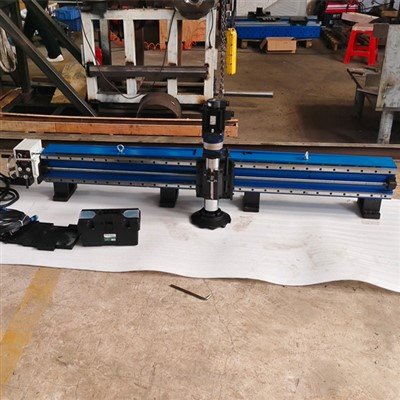
Hey there! As a supplier of linear milling machines, I often get asked about the differences between three-axis and five-axis linear milling machines. It’s a great question, and today, I’m gonna break it all down for you in a way that’s easy to understand. Linear Milling Machine

Three – Axis Linear Milling Machines
Let’s start with the three – axis machines. These bad boys have been around for ages and are still a staple in many workshops. The three axes refer to the X, Y, and Z directions.
The X – axis usually controls the left – to – right movement of the milling cutter or the workpiece. Think of it as moving your tool horizontally across the top of the material. The Y – axis is all about forward and backward movement. Picture pushing the material towards or away from the cutter. And the Z – axis? That’s the up – and – down movement, allowing the cutter to plunge into the material or lift off it.
One of the biggest advantages of three – axis machines is their simplicity. They’re pretty easy to operate, especially for beginners. If you’re just starting out in the machining world, a three – axis linear milling machine can be a great place to learn the ropes. You don’t have to deal with a whole bunch of complex controls and programming.
These machines are also more affordable than their five – axis counterparts. If you’re on a tight budget, a three – axis machine can get the job done for many basic to moderately complex tasks. They’re great for making flat surfaces, slots, and drilling holes in a simple, straightforward manner.
But, of course, they have their limitations. Since they only have three axes of movement, they’re not the best for creating complex 3D shapes. For example, if you want to make a part with undercuts or highly curved surfaces, a three – axis machine might struggle. You’d have to reposition the workpiece multiple times, which is time – consuming and can lead to less accurate results.
Five – Axis Linear Milling Machines
Now, let’s talk about the five – axis machines. In addition to the X, Y, and Z axes, they have two additional rotational axes. These rotational axes can be either around the X and Y axes or the Y and Z axes, depending on the machine’s design.
The extra two axes give these machines a whole new level of flexibility. They can reach almost any angle on the workpiece without having to re – position it. This means you can create incredibly complex 3D shapes in one single setup. For example, you can make aerospace components, high – end automotive parts, or even custom – designed jewelry that has intricate curves and angles.
The precision of five – axis machines is also top – notch. With the ability to continuously adjust the cutter’s orientation relative to the workpiece, they can achieve very high – quality finishes. The reduced need for re – positioning also minimizes the chances of errors that can occur during the setup process.
However, all these features come at a cost. Five – axis linear milling machines are more expensive to purchase and maintain. They require more advanced programming skills because you have to take into account the additional rotational movements. So, if you’re not experienced with CNC programming, you might need to invest some time in training your staff or hiring someone with the right skills.
Key Differences Summarized
If we sum it all up, the main differences between three – axis and five – axis linear milling machines are mainly in terms of complexity, cost, and capabilities.
Complexity: Three – axis machines are much simpler in terms of operation and programming. You’re basically dealing with three linear movements. On the other hand, five – axis machines are a whole different ball game. You’ve got to consider the two extra rotational axes, which adds a lot more complexity to the programming and setup.
Cost: Three – axis machines are generally more budget – friendly. They’re a great option if you’re just starting out or if you have a limited budget for equipment. Five – axis machines, however, are a significant investment. But if you’re in an industry that requires high – end, complex parts, the investment can pay off in the long run.
Capabilities: Three – axis machines are great for basic to moderately complex tasks like making flat surfaces and simple holes. Five – axis machines, with their extra axes of movement, are designed for creating highly complex 3D shapes with precision and efficiency.
Which One Should You Choose?
So, which machine is right for you? Well, it depends on your specific needs. If you’re a small – scale workshop that mainly does simple machining jobs like making brackets or small parts with flat surfaces, a three – axis linear milling machine might be all you need. It’s cost – effective and easy to operate.
But if you’re in a high – tech industry such as aerospace, automotive, or medical device manufacturing, where precision and the ability to create complex shapes are crucial, a five – axis machine is probably the way to go. It might be a big investment upfront, but the increased productivity and quality of the parts you can produce can more than make up for it.
Get in Touch
Linear Milling Machine If you’re still not sure which machine is the best fit for your business, or if you want to learn more about our range of linear milling machines, don’t hesitate to reach out. We’ve got a team of experts who can answer all your questions and help you make the right decision. Whether you’re interested in a three – axis or a five – axis machine, we’ve got the knowledge and experience to guide you through the process.
References
- “CNC Machining Handbook”, a well – known guide in the machining industry that covers the basics of three – and five – axis milling.
- “Advanced Manufacturing Technologies Journal”, which has several research papers on the capabilities and applications of different types of milling machines.
Shangqiu JDA Machinery Technology Co., Ltd.
With abundant experience, we are one of the most professional linear milling machine manufacturers and suppliers in China. We warmly welcome you to buy cheap linear milling machine for sale here from our factory. Quality products and reasonable price are available.
Address: No. 55 Pingyuan Middle Road, Liangyuan District, Shangqiu, Henan, China
E-mail: sales@jdamachines.com
WebSite: https://www.jdamachines.com/
