Hey everyone, if you’ve ever stood next to a working oilfield pump—whether it’s a centrifugal, reciprocating, or positive displacement unit—you know they’re the unsung workhorses keeping operations moving. But let’s cut to the chase: I get asked all the time by new operators, small lease crews, even seasoned general managers: “What’s the REAL maintenance cost for a typical oilfield pump?” No corporate spreadsheets, no vague industry jargon, just the stuff that actually hits your pocket every month. As an oilfield pump supplier, I’ve seen this play out on hundreds of sites, so let’s break it down straight. Oilfield Pump

First, let’s set the table with what we’re actually talking about here. A “typical oilfield pump” isn’t some crazy custom unit for a deepwater rig—this is the workhorse you’ll find on onshore well sites, lease crude transfer, water injection, or pipeline booster stations. Most sites run a centrifugal pump (super common for general transfer) or a small reciprocating pump for high-pressure injection, and they see 8,000 to 8,760 hours a year—barely any downtime, just constant wear from sand, corrosive brine, and the harsh Texas/Oklahoma/North Dakota heat and cold. These aren’t the fancy offshore models that cost six figures upfront; we’re talking about units that sell for $5k to $50k depending on size, and their maintenance costs don’t follow a one-size-fits-all rule, but there are clear patterns.
Let’s start with the big, monthly number you’ll see first: routine scheduled maintenance. This is the stuff you do on a set schedule—no surprise breakdowns, just sticking to the playbook. For a standard 150HP centrifugal pump (the most common on small to mid-sized sites), I tell crews to stick to OEM guidelines: every 500 operating hours, pull the pump out, replace the mechanical seal, check the impeller for sand erosion, and re-grease the bearing housings. Every 2,000 hours, you do a full bearing replacement and align the pump-motor shaft. Now, let’s put dollar signs to that. A mechanical seal for a 150HP centrifugal? You’re looking at $400 to $600, not the knockoff garbage from Amazon that falls apart in 2 weeks. A set of bearings? Another $300 to $500. Grease and alignment tools? Maybe $50 total per service call. Now, multiply that out: 8,000 hours a year means 16 seal changes, 4 bearing replacements. That’s (16 x $500) + (4 x $400) = $8,000 just for parts, plus labor. Most lease operators pay a local mechanic $120 to $150 an hour, and a routine 500-hour service takes 3 hours, so that’s $450 per service, plus a few extra hours for the 2,000-hour bearing swap ($600 each). Total labor for the year: 16 x $450 + 4 x $600 = $9,600. So routine scheduled maintenance for a 150HP centrifugal? Roughly $17,600 a year.
Wait, but reciprocating pumps? Let’s not sleep on those, they’re the workhorses for water injection. A 100HP reciprocating pump is super common for small injection wells, and their maintenance is a bit different because they have more moving parts: pistons, valves, rods. Every 300 hours, you replace the fluid end valves and seats—those take a beating from the harsh brine and sand. A set of valves for a 100HP reciprocating is $250 to $350 per valve, and you’ll need 4 valves per cylinder, usually 2 cylinders. Plus piston rings: $150 a set, replaced every 1,000 hours. Then there’s the power end lube, replaced every 200 hours, about $100 worth of oil. Labor is similar, but reciprocating services take a bit longer because you’re taking apart more parts: 4 hours every 300 hours, 6 hours every 1,000 hours for piston rings. Total for a 100HP reciprocating? Roughly $12,000 a year for parts and labor. Makes sense, they’re smaller, so less wear overall.
But here’s the part no one talks about: unplanned emergency maintenance. That’s the stuff that hits you when you least expect it—when the pump seizes up at 2 a.m. on Christmas, or the seal blows mid-transfer and you spill a barrel of crude. I’ve seen guys write off $5k in a single day because a bearing locked up and fried the motor, or an impeller eroded so bad the pump lost 30% of its flow and they didn’t catch it until the well pressure dropped. For the 150HP centrifugal pump I mentioned earlier, emergency costs usually run $3k to $7k a year. Why the range? Because if you skip a seal change, that can leak brine into the bearing housing and destroy the whole motor—motor replacement is $3k right there. If you catch it early, it’s just a new seal and a bearing, maybe $1k. For reciprocating pumps, unplanned hits are lower, around $2k to $4k a year, because the parts are a bit simpler to replace fast, but the valves can still snap if sand gets in, and that’s a quick expensive fix.
Wait, but don’t forget the hidden costs—those are the ones that make your blood pressure rise. Let’s say your pump seizes up and you have to shut down a well for 12 hours. A typical well flowing 50 barrels a day? That’s 25 barrels lost, right now crude was $70 a barrel a few months back, that’s $1,750 in lost production. Or water injection: if your water injection pump goes down, you can’t maintain well pressure, which leads to lost production, maybe even formation damage that costs you $10k to fix long-term. I once had a client who skipped a $50 seal change, ended up with a $12k motor replacement plus $8k in lost production because their transfer pump went down on a weekend. Ouch. That’s the stuff that doesn’t show up on the parts invoice, but it’s way bigger.
Now, what about factors that make this number go up or way down? Let’s be real—no two sites are the same. First, how dirty is your fluid? If you’re pumping water with a high sand content (we call that “abrasive load” in the business), impeller and valve wear is 2x faster, so you’ll replace parts twice as often. I had a client in West Texas pumping produced water with 50ppm sand, their maintenance costs jumped 40% that year. Second, do you use OEM parts or cheap knockoffs? I see guys saving $200 on a seal, then having to replace it 3 times a year instead of once. Total cost for the year? $600 instead of $500, and that’s not even counting the downtime. Third, do you have a dedicated maintenance tech, or do you call a mechanic every time? If you have an in-house guy who can do the basic services, you’ll cut labor costs in half—maybe $4k a year saved, that’s not nothing. Fourth, how old is your pump? A 10-year-old pump with worn shafts and misaligned motors is going to have way more emergency breakdowns than a 2-year-old unit that’s been properly maintained. I tell clients: spend an extra $1k on a pump inspection when you buy it, and you’ll cut maintenance costs by 20% for the first 5 years.
Wait, let’s put all this together for a real example, so you can see the total. Let’s take a mid-sized onshore site with two 150HP centrifugal pumps for well transfer and water injection. Scheduled maintenance: $17,600 x 2 = $35,200. Unplanned maintenance: $5,000 average per pump = $10,000. Now, hidden costs: let’s say average 24 hours of downtime a year between both pumps, that’s $3,500 in lost production. Total annual maintenance and associated costs: $48,700. Divide that by two pumps, that’s ~$24,350 per pump per year. But wait, if they use OEM parts, do scheduled services on time, and have an in-house tech, that number drops to ~$18,000 per pump. If they skip services and use cheap parts? That number jumps to $35,000 per pump, easy.
Now, let’s compare that to the upfront cost of a new pump. A 150HP centrifugal pump from our shop is about $22k, so after two years, if their maintenance is $18k a year, they’ve spent almost as much on maintenance as the pump itself. But if they keep up on maintenance, they can get 15 to 20 years out of that pump— I have pumps we sold in 2005 still running strong on sites in Oklahoma. The guys who skip maintenance? Their pump dies in 5 years, and they’re replacing it early.
One thing I always harp on is predictive maintenance, not just scheduled. A lot of operators still go by the old “every 500 hours” rule, but with modern tech, you can hook up vibration sensors to your pump, and they’ll tell you when the bearing is going bad, or the impeller is eroding, before it seizes up. That cuts unplanned maintenance by 60%—I had a client in North Dakota do that, their emergency costs went from $6k a year to $1.5k. Yeah, the sensors cost $500 a pump, but that’s a one-time cost that pays for itself in 3 months.
Wait, let’s address a common myth I hear all the time: “I can get a pump from China for half the price, so maintenance will be cheaper.” No way. Those cheap pumps use lower-grade materials, the seals are not engineered for oilfield conditions, and the bearings are standard off-the-shelf garbage. I had a client buy a $10k Chinese centrifugal pump instead of our $22k OEM one, and in 18 months, the impeller eroded so bad it couldn’t move 10% of the flow it was rated for. Maintenance costs for that cheap pump? $12k a year, and now he has to replace it anyway, total cost: $22k + $12k1.5 = $40k, vs $22k + $18k1.5 = $49k? Wait no, actually, the cheap pump broke down so much he had more downtime, so total was way higher. Save up for a quality pump, and your maintenance costs will be way lower in the long run.
Another thing: if you’re running a pump that’s not the right size for your job. I see guys under-sizing pumps to save upfront cost, so they’re running at 110% capacity 24/7, that means every part is wearing out faster. Or over-sizing, so the pump is cycling on and off all the time, which wears the bearings way faster. I always do a site assessment before selling a pump, make sure it’s the right size for their flow and pressure needs. That small adjustment cuts maintenance costs by 15% easy.
So to wrap this up, let’s get back to the original question: what’s the cost of maintenance for a typical oilfield pump? It’s not a single number, but for a standard 150HP centrifugal (the most common on onshore sites), it’s roughly $15k to $25k a year, depending on maintenance practices, fluid abrasiveness, and whether you use OEM parts. For reciprocating pumps, it’s $10k to $20k a year. And don’t forget the hidden downtime costs—those can add another $5k to $20k a year, depending on your site’s production.
Look, I’ve been selling oilfield pumps for 12 years, and the number one thing that saves operators money is not buying the cheapest parts, or skipping a service, but sticking to a consistent maintenance plan. If you’re tired of unexpected breakdowns eating into your profits, or want to make sure your pump costs are predictable, let’s chat. I can come out to your site, run a quick assessment, recommend a maintenance schedule tailored to your pumps, and even help you get set up with quality parts that don’t break the bank. No sales pitch, just real advice from someone who’s been in the field with you. If you’re ready to stop throwing money at emergency repairs, reach out to discuss your pump needs.
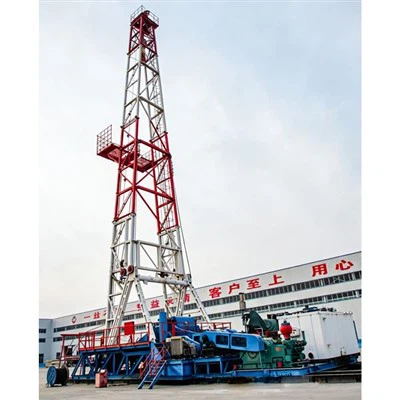
Truck-Mounted Drilling Rigs References:
- American Petroleum Institute. (2021). Recommended Practice for Maintenance, Operation, and Safety of Oilfield Pumps (API RP 11P). American Petroleum Institute.
- Oil and Gas Journal. (2022). Annual Survey of Onshore Oilfield Equipment Maintenance Costs. Oil and Gas Journal, 120(5), 42-48.
- Hydraulic Institute. (2020). Centrifugal Pump Maintenance Best Practices for Abrasive Fluid Applications. Hydraulic Institute Press.
- U.S. Energy Information Administration. (2023). Well Downtime Costs and Production Losses for Onshore Oil and Gas Operations. U.S. Department of Energy.
Shandong Rongli Intelligent Manufacturing Co., Ltd.
We’re well-known as one of the leading oilfield pump manufacturers and suppliers in China, featured by quality products and good price. Please rest assured to wholesale high-grade oilfield pump for sale here from our factory. Also, quotation is available.
Address: No.3336, Haidai North Road, Qingzhou City, Shandong Province, 262515, P.R.C.
E-mail: Support@rongligroup.com
WebSite: https://www.oilequipmentsupply.com/
