If you’ve ever stood on the manufacturing floor watching a 5 axis machining center carve a complex aerospace turbine blade or a custom medical implant from a solid block of titanium, you know it’s not just about the spindles or the tilt ranges. What makes these machines actually productive, day in and day out, is something that almost never makes it into the spec sheet’s flashy hero shots: tool magazine capacity. As a supplier of 5 axis machining centers, I get asked about this more than I get asked about chip-to-time rates or linear axis acceleration—and for good reason. The size of your tool magazine doesn’t just dictate how many parts you can run unattended; it shapes your whole production workflow, your labor costs, and even the quality of your final parts. 5 Axis Machining Center
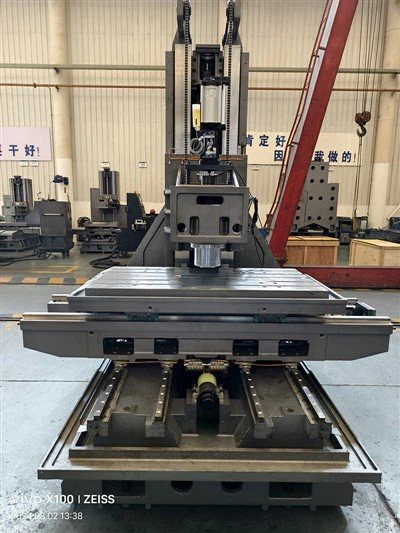
Let’s start with the basics. What is a tool magazine, exactly? On a machining center, the tool magazine is the rotating or linear storage unit that holds all the cutting tools the machine will use for a job—end mills, drill bits, tapers, face mills, custom form tools, even specialized probing tools for in-process inspection. When the machine needs to switch from drilling a hole to contouring a surface, it pulls the next tool from the magazine, swaps it into the spindle in a matter of seconds, and gets back to work. The capacity is the number of individual tools that can fit in that storage unit. For 3 axis machines, this is usually a straightforward number: a standard vertical machining center might have 24, 30, or 40 tools, and that’s that. But 5 axis machining centers are different. Their capacity isn’t one-size-fits-all, and it’s tied directly to what you actually need to cut.
Here’s the first thing I tell new customers who walk into our demo lab: don’t look for a “one-size” capacity. A 5 axis machine that’s perfect for a job shop making small aluminum aerospace brackets needs a totally different magazine than one running large, monolithic titanium parts for gas turbines. Let’s break down the common capacity ranges, and when each makes sense for your operation.
First, the low end: compact 5 axis machining centers, usually built for small to medium parts, with work envelopes under 1,000 x 1,000 mm. These typically have magazine capacities from 16 to 32 tools. You might think that’s too small, but for a job shop focused on prototypes or low-volume, high-mix parts, this is actually ideal. Why? Because these machines are often paired with manual or semi-automated part loading, and you don’t want to waste space on tools you’ll only use once. For example, if you’re machining a small aluminum medical implant, you might only need a 2 mm drill, a 6 mm end mill, a tap, and a single radius contouring tool. A 16-tool magazine fits exactly that, and keeps the machine agile, with a smaller footprint that’s easier to fit into a crowded shop floor. I’ve seen these compact machines run unattended for 8 to 10 hour shifts with a 24-tool magazine, as long as the job doesn’t require specialized custom tools. The tradeoff here is flexibility: if a new project comes in that needs a form tool you don’t have loaded, you’ll have to pause production to swap tools manually, which eats into your uptime.
Next, the mid-range: 32 to 60 tool capacity. This is the sweet spot for most general-purpose 5 axis applications, from automotive prototype parts to small turbine components, custom molds and dies, and even complex aerospace structural brackets. What makes this range useful is balance: it gives you enough space to handle most common jobs without being so large that it adds unnecessary weight, complexity, or cost to the machine. Let’s take a mold making job as an example: a die for a plastic automotive bumper might require 35 tools, from roughing end mills to finishing ball noses, thread mills for cooling channels, and even a 3D probing tool to check the part mid-cycle. A 40-tool magazine fits all of these, and you can run the job overnight without needing a tool change. I worked with a mold maker in Detroit last year who switched from a 24-tool 3 axis machine to a mid-range 5 axis machine with a 40-tool magazine. His uptime jumped 40% in the first quarter, because he no longer had to stop every 2 hours to swap tools, and he could add 5 axis operations that would have required him to split the job across two machines before. The mid-range is also versatile enough for low-volume production runs, where you might run 10 of a part that uses 25 tools, leaving space for a backup drill or a spare end mill in case of wear.
Then there’s the high end: 60 to 120+ tool capacity. These are the large-format 5 axis machining centers, built for monolithic part production, high-volume aerospace components, or complex medical devices like custom orthopedic implants that require multiple operations. A gas turbine blade, for example, is machined from a 50 kg block of titanium, and needs a dozen or more tools just for roughing the airfoil, plus tools for finishing the leading and trailing edges, drilling cooling holes (some of which are angled, requiring specialized gun drills), and even polishing tools. These large machines often have rotary tool magazines, sometimes called carousel magazines, that extend along the side of the machine, or even dual magazines in some cases, to fit all those tools. I’ve installed machines with 120-tool capacity for an aerospace customer in the Pacific Northwest, and they run 24/7, with lights-out production for 3 days straight, swapping tools automatically as needed. The only downside here is cost: these magazines add weight to the machine frame, and the tool change mechanism has to be more robust to handle the extra number of tools, which increases the machine’s upfront price. But for high-volume production, that cost is offset by the fact that you don’t have to dedicate multiple machines to the same part, and you can run unattended for days at a time.
Wait a second—why is 5 axis different from 3 axis when it comes to tool capacity? That’s a question I get all the time. The short answer is: tool change complexity. On a 3 axis machine, the spindle moves up and down, and the tool magazine is usually vertical or horizontal, close to the spindle. Tool change is a linear movement: the spindle pulls out the old tool, moves a few inches to the magazine, pulls in the new tool, and goes back to work. On a 5 axis machine, you have two extra rotary axes—usually a B axis that tilts the spindle, and a C axis that rotates the table. That means the tool has to reach the magazine even when the spindle is tilted at 90 degrees, or the table is rotated 180 degrees. If the magazine is too large, it can interfere with the rotary axes. We see this all the time with cheap imported 5 axis machines: they cram a 60-tool magazine into a machine frame that can only handle a 30-tool magazine, because they cut corners on the frame design. The result is constant crashes, long tool change times, and reduced machine movement. That’s why, as a supplier, we don’t just sell a machine with a big number of tools on spec sheet—we engineer the magazine to work with the rotary axes. For example, our mid-range 5 axis machines have a 40-tool carousel that’s positioned high enough above the work envelope to avoid interference when the spindle tilts to 110 degrees, which is standard for contouring airfoils.
Another common misconception: more tools = better. That’s only true if you actually need them. I had a customer a few years ago who bought a large 5 axis machine with a 100-tool magazine, thinking it would make his production faster. His job shop mostly ran small parts that required 20 tools at most, so the extra 80 tools were just taking up space, adding unnecessary weight to the machine, and slowing down his tool change time. The tool change time on his machine went from 2.5 seconds (standard for a good 5 axis machine) to 4 seconds, because the magazine had to rotate further to reach tools. He ended up trading it in for our mid-range 40-tool model, and his throughput went up 15% because of the faster tool changes. So it’s important to match capacity to your actual workflow, not just the biggest number you can find.
What about special tools? Things like custom form tools, diamond-coated finishing tools, or probing tools—do those count towards capacity? Absolutely, and they’re often the reason you need a larger magazine. A lot of shops forget that inspection tools take up space. In-process probing, which checks part dimensions mid-cycle to adjust for tool wear or thermal expansion, is a critical part of 5 axis machining, especially for tight-tolerance parts like medical implants. If you have a 24-tool magazine and you load a probe, that’s one less tool you can use for cutting. So if you use probing, you should add at least one tool slot to your count to plan for that. Custom form tools are another: if you’re machining a complex mold with a unique contour, you might only use that one tool, but you can’t run without it, so you need to reserve a slot for it.
So how do you calculate the right tool magazine capacity for your 5 axis machining center? Let me give you a simple framework, based on 15 years of working with shops across North America:
First, list all the operations you do for your most common job. If you run multiple jobs, take your average job, not your most complex one or your simplest one.
Second, count how many tools you need for that job: roughing end mills, finishing end mills, drills, taps, form tools, probes, any specialized tools.
Third, add 20% for backups and future projects. Tools wear out, so having a backup drill or end mill avoids stopping production if one breaks. It also gives you space to take on a new job without reloading tools.
Fourth, check the machine’s work envelope. If you have a small compact machine, you can’t add too many tools without causing interference, so stick to the lower end of your range. For large format machines, you can go higher, but don’t add slots you don’t need.
For example: a job shop making custom industrial valves. Average job needs 28 tools (10 roughing, 10 finishing, 4 drills, 2 taps, 1 probe, 1 form tool). 20% extra is about 6, so total needed is 34. That puts you right in the mid-range 32-60 tool sweet spot, so a 40-tool magazine would be perfect. If you’re running gas turbine blades, average job needs 75 tools, 20% extra is 15, so 90 tools—so you’d need a high-capacity 100-tool magazine, paired with a large-format machine that can handle the rotary axis movement without interference.
As a supplier, we also customize magazine capacities for specific jobs. We’ve worked with aerospace customers that have very long production runs of a single part, so we can design a custom dual-magazine system that holds 180 tools, all pre-loaded, so they can run the part for 2 weeks straight without touching the machine. For job shops with high mix, low volume, we offer quick-change magazines that let you swap out a set of tools in 15 minutes, so you don’t have to keep 60 tools loaded all the time.
At the end of the day, tool magazine capacity is a balancing act between what you need today, and what you might need tomorrow. It’s not just a number on a spec sheet—it’s a core part of your machine’s productivity, uptime, and flexibility. Too small, and you’re stopping constantly to swap tools, wasting labor and machine time. Too large, and you’re paying for capacity you’ll never use, with slower tool changes and higher maintenance.

If you’re in the market for a 5 axis machining center and you’re not sure what magazine capacity is right for your shop, don’t guess. Talk to an experienced supplier who can walk you through your workflow, look at your current production, and help you pick the right machine. We work with shops of all sizes, from 2-person prototyping operations to large aerospace manufacturers, and we can design a solution that fits your needs, not just a one-size-fits-all spec. If you’re ready to learn more, reach out to our team to discuss your machining needs and find the right 5 axis solution for your production.
Aluminum Cnc Machine References:
- "5 Axis Machining: Fundamentals and Applications", Society of Manufacturing Engineers, 2021
- "Tool Storage and Automation for High-Volume Machining", Manufacturing Engineering Magazine, Vol. 168, No. 3, 2022
- "Workcell Design for Unattended Machining", SME Robotics and Automation Division, 2020
- "Machining Center Specification Guide", Association for Manufacturing Technology, 2023
Smartech Machinery & Equipment Co., Ltd.
As one of the most professional 5 axis machining center machine manufacturers and suppliers in China, we also support customized service. Please rest assured to buy bulk 5 axis machining center machine made in China here from our factory. Contact us for more details.
Address: Room 2832, Changping Commercial Mansion, Shihua Road, Futian Free Trade Zone, Shenzhen, China
E-mail: smartech@smartechcnc.cn
WebSite: https://www.smartech-cnc.com/
